Are you planning to get a prestigious government job through the SSC CGL 2026 exam? To win this race, you don’t just need to study hard—you need to study smart. The first step is understanding the SSC CGL Syllabus and the latest exam pattern.
The Staff Selection Commission (SSC) has made significant changes in recent years. Today, Tier 1 is just a “gatekeeper” (qualifying), while Tier 2 is the “kingmaker” that decides your final selection.
In this guide, we break down every topic in simple words so you can start your preparation today.
🚀 Get Govt Job Alerts Before Everyone Else (Join Now)
Before you start preparing, it is very important to understand the basic structure of the SSC CGL exam. The Staff Selection Commission conducts this exam to recruit candidates for various Group B and Group C posts in central government departments.
👉 Note: This is one of the most popular government exams in India, with lakhs of aspirants appearing every year.
Basic Exam Details at a Glance
Particular
Details
Exam Name
SSC CGL (Combined Graduate Level)
Conducting Body
Staff Selection Commission (SSC)
Exam Level
National Level
Mode of Exam
Online (Computer Based Test – CBT)
Frequency
Once a year
Qualification
Graduation (Final year students can also apply)
Job Type
Central Government Job (Gazetted & Non-Gazetted)
/ssc-cgl-syllabus-2026/
SSC CGL Exam Stages
The SSC CGL exam is conducted in two main stages (Tiers). There is no interview for any post.
✔️ Tier 1 (Preliminary Exam):
Objective type (MCQs).
Qualifying in nature (Marks not added to final merit).
4 subjects: Reasoning, GK, Maths, and English.
✔️ Tier 2 (Main Exam):
More advanced level and most important stage.
Determines final selection and post allocation.
Includes Paper 1 (Compulsory for all) and Paper 2 (Only for JSO posts).
✔️ Tier 3 (Document Verification): Final step where your original certificates are checked.
SSC CGL Exam Duration & Questions
Stage
Time Duration
Question Type
Tier 1
60 Minutes
Objective (MCQs)
Tier 2 (Paper 1)
2 Hours 15 Minutes
Objective (MCQs) + Typing
Tier 2 (Paper 2)
2 Hours
Objective (Statistics)
Negative Marking (Very Important)
Guesswork can ruin your chances of selection. SSC has a strict negative marking policy:
Tier 1:0.50 marks deducted for each wrong answer.
Tier 2 (Paper 1):1 mark deducted for each wrong answer in Maths, Reasoning, English, and GA.
Tier 2 (Paper 2):0.50 marks deducted for each wrong answer.
Expert Tip: Since Tier 2 has a high penalty (1 full mark), only attempt questions you are 100% sure about.
1. SSC CGL Exam Pattern 2026: The Big Picture
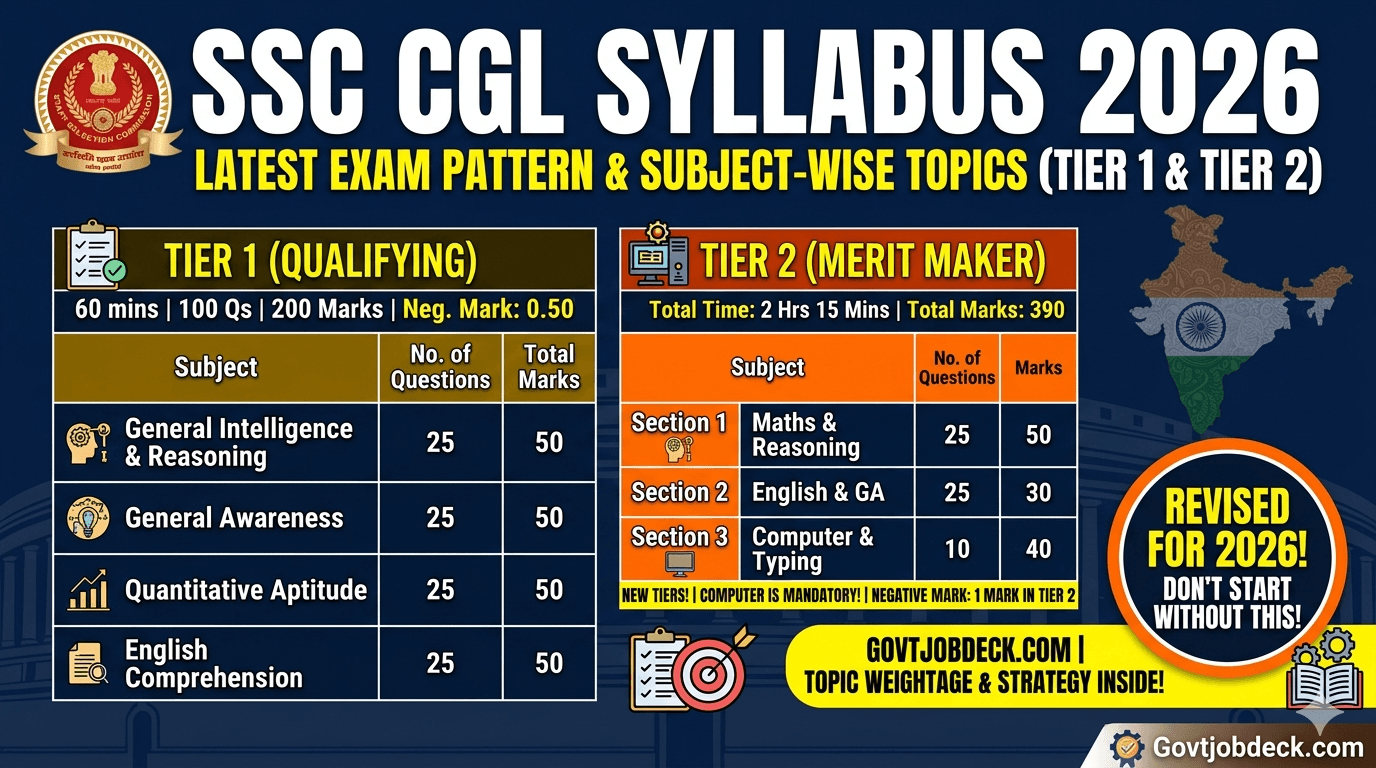
Before we dive into the topics, let’s look at how the exam is structured. The SSC CGL exam happens in two main stages: Tier 1 and Tier 2.
Tier 1: The Qualifying Stage
Think of Tier 1 as an entry ticket. You must pass this to reach the next level, but these marks won’t be added to your final score.
Subject
Questions
Marks
Time
Reasoning
25
50
60 Minutes
General Awareness
25
50
(Total Time)
Maths (Quant)
25
50
English
25
50
Total
100
200
Note: There is a negative marking of 0.50 marks for every wrong answer in Tier 1.
Tier 2: The Final Selection Stage
This is where your rank is decided. It is divided into sections with a time lock (you cannot switch sections whenever you want).
Section 1: Maths (30 Qs) + Reasoning (30 Qs) — Total 180 Marks
Section 2: English (45 Qs) + General Awareness (25 Qs) — Total 210 Marks
Section 3: Computer Knowledge (20 Qs) — Qualifying only
This section tests how you think. It is usually the highest-scoring part of the exam.
Key Topics: Analogies, Number Series, Coding-Decoding, Blood Relations, Syllogism, Venn Diagrams, and Mirror Images.
Long-term Strategy: Practice “Non-verbal reasoning” (pictures/patterns) daily. It is easy but takes time if you haven’t practiced.
B. General Awareness (GK)
This is the widest section. Don’t try to memorize everything; focus on high-weightage areas.
History & Culture: Ancient, Medieval, and Modern India.
Polity: The Indian Constitution and Parliament.
Geography: India and its neighbors.
Science: Basic Biology, Physics, and Chemistry (10th-grade level).
Current Affairs: Focus on the last 6–8 months of news.
C. Quantitative Aptitude (Maths)
SSC loves Arithmetic and Advanced Maths equally in Tier 1.
Arithmetic: Percentages, Profit & Loss, Ratio, Time & Work, and Interest (SI/CI).
Advanced Maths: Geometry, Mensuration (2D/3D), Algebra, and Trigonometry.
Data Interpretation: Reading Pie charts and Bar graphs.
D. English Comprehension
The focus here is on grammar and reading speed.
Vocabulary: Synonyms, Antonyms, and One-word substitutions.
Grammar: Spotting Errors, Active/Passive Voice, and Direct/Indirect Speech.
Reading: Cloze Test and Reading Comprehension passages.
3. SSC CGL Tier 2 Syllabus: The “Merit” Phase
In Tier 2, the level of questions becomes harder. Specifically, English and Maths carry the most weight.
Section 1: Mathematical Abilities & Reasoning
New Addition: Statistics and Probability. You must learn how to calculate Mean, Median, Mode, and Standard Deviation.
Reasoning: In Tier 2, reasoning includes “Critical Thinking” and “Emotional Intelligence” type questions.
Section 2: English & General Awareness
English (45 Questions): This is the biggest section. Focus on “Para Jumbles” (ordering sentences) and long Reading Comprehension passages.
General Awareness: Expect deeper questions on Government Schemes and Economic Surveys.
Section 3: Computer Knowledge (The Silent Killer)
Many students score high in Maths but fail because they ignore Computers. You must qualify for this section.
Basics: RAM, ROM, Operating Systems (Windows).
Software: MS Word, MS Excel (Shortcuts are very important).
Internet: Networking, Cyber Security, and E-mails.
4. Topic-Wise Weightage: Where to Focus?
To rank in the top 10, you shouldn’t study everything with the same intensity. Here is the Govtjobdeck Expert Analysis on weightage:
Subject
High-Weightage Topics
Why?
Maths
Geometry & Algebra
They make up 30-40% of the Advanced Maths section.
English
Reading Comprehension
15+ marks come from just reading and answering.
Reasoning
Coding & Series
These appear in every single shift of the exam.
GK
Polity & Science
These have “fixed” answers. Either you know it or you don’t.
5. Post-Specific Syllabus (JSO & AAO)
If you applied for special posts, you have to give an extra paper:
Junior Statistical Officer (JSO): You must study Paper 2: Statistics. This includes Data Collection, Sampling Theory, and Hypothesis Testing.
Assistant Audit Officer (AAO): Note that as per the 2026 cycle, always check the official notification as Paper 3 (Finance & Economics) undergoes frequent updates or removals depending on the specific recruitment year.
6. How to Download SSC CGL Syllabus PDF?
To get the most authentic version of the syllabus, we recommend downloading it directly from the Staff Selection Commission.
The “Real” PDF Link: The most accurate syllabus is always found in the latest Examination Notice. While you can use the Direct Official PDF Link for a quick overview, the Staff Selection Commission (SSC) releases an updated notification every year.
Check the “Notice Board”: On the homepage, look for the notice titled “Combined Graduate Level Examination, 2026” (usually released in the first half of the year).
Open the PDF: This document is the “Notification.”
Find the Syllabus Section: Scroll down to the “Scheme of Examination” and “Indicative Syllabus” sections (usually around page 20-30).
Use the Calendar for Dates: If the specific CGL notice isn’t out yet, check the Official SSC Exam Calendar (Note: Link updates annually) to see when the new syllabus will be officially released.
Why check the Notification? The Notification PDF is the only place where SSC officially confirms if there are small changes in weightage or new topics like “Probability” or “Computer Knowledge” for that specific year.
7. Expert Preparation Tips for 2026
Daily Calculation: Spend 15 minutes every morning on tables, squares, and cubes. This saves time in the Maths section.
The 3-Step GK Rule: Read news daily, watch a weekly summary, and give a monthly quiz.
Mock Tests: Start giving mocks once you complete 60% of the syllabus. The goal isn’t marks; it’s learning to manage the 1-hour time limit.
Computer is Must: Give at least 2 hours a week to Computer basics from day one.
Q1: Is there any change in the SSC CGL 2026 Syllabus?
The core subjects remain the same, but the weightage of Statistics and Probability in Tier 2 has increased. Also, remember that Tier 1 marks are no longer used for the final merit list.
Q2: Is the SSC CGL exam hard for beginners?
Not if you have a plan. The syllabus is based on 10th and 12th-grade concepts. The challenge is “Speed,” not the “Difficulty” of questions.
Q3: Can I skip Advanced Maths?
No. In Tier 2, Advanced Maths (Geometry, Trigonometry, etc.) covers nearly 50% of the section. You cannot get a good post without it.
Q4: What is the negative marking in Tier 2?
In Tier 2 Paper 1, for every wrong answer, 1 mark is deducted. This is very high, so avoid guessing!
Q5: What is SSC CGL syllabus?
SSC CGL syllabus includes Maths, Reasoning, English, and General Awareness for Tier 1 and Tier 2 exams.
Q6: Does SSC CGL syllabus change every year?
No, most of the syllabus remains the same. Only small updates may happen.
Q7: How many tiers are there in SSC CGL?
There are mainly 2 tiers: Tier 1 and Tier 2.
🚀 Get Govt Job Alerts Before Everyone Else (Join Now)
Sandeep Dev researches and verifies government recruitment notifications using official advertisements, government recruitment portals, and official notifications. Every article published on GovtJobDeck is reviewed for accuracy, clarity, and timely updates before publication.
✔ Official Notification Verification✔ Editorial Review Process✔ Regular Content Updates